Grains and Legumes: Large-Scale Cooking Profiles
Grains and legumes represent significant components in many meal structures. Understanding their cooking profiles is essential for batch preparation planning, as these ingredients demonstrate distinct behaviours when prepared in larger quantities. Unlike proteins, which show minimal time savings in batch contexts, grains and legumes show substantial economies when cooking times are considered per portion.
Rice: White and Brown Varieties
White Rice
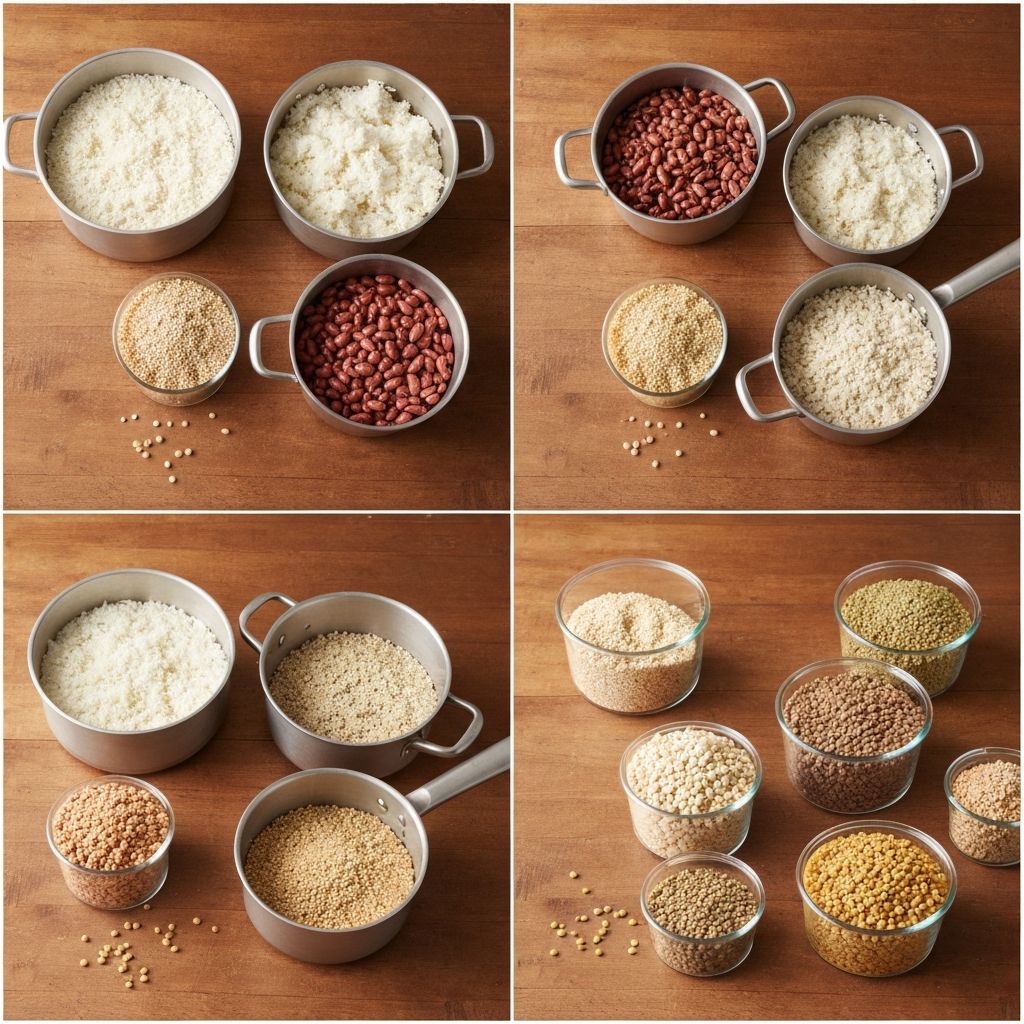
White rice is milled grain with the bran and germ removed. Cooking requires a 2:1 water-to-rice ratio by volume. White rice cooks in 12–15 minutes. This cooking time is unaffected by quantity—200g of white rice takes 15 minutes, as does 2kg of white rice in an appropriately sized pot.
Brown Rice
Brown rice retains the bran layer, which requires longer cooking. Brown rice requires a 2.5:1 water-to-rice ratio and cooks for 35–40 minutes. Like white rice, cooking time is largely independent of quantity.
Batch Cooking Efficiency for Rice
Cooking 100g of rice takes 15 minutes for white rice or 40 minutes for brown rice. Cooking 1kg takes the same time. The time per portion is therefore reduced approximately tenfold through batch cooking, making rice an ideal candidate for this approach.
Quinoa and Ancient Grains
Quinoa is technically a seed, though it is used similarly to grains in meal contexts. Quinoa cooks in 12–15 minutes using a 2:1 water-to-quinoa ratio.
Like rice, quinoa shows minimal time variation with batch cooking quantities. A 100g batch and a 1kg batch cook in identical times.
Lentils: Brown, Green, and Red
Red Lentils
Red lentils are hulled and split, making them quick-cooking. They require no soaking and cook in 15–20 minutes using a 2.5:1 water-to-lentil ratio. Red lentils break down during cooking, making them unsuitable for preparations where whole grains are desired, but ideal for lentil soups or purees.
Brown and Green Lentils
These retain their hulls and cook in 20–30 minutes using a 2:1 water-to-lentil ratio. No soaking is required. They hold their shape during cooking better than red lentils, making them suitable for mixed-component meals.
Beans: Kidney, Black, and Chickpeas
Dried beans require preparation before cooking. The standard method involves overnight soaking (8–12 hours) or rapid soaking (boil for 2 minutes, then rest for 1 hour).
After soaking, beans are drained and cooked in fresh water. Cooking times vary by type: kidney beans cook in 45–60 minutes, black beans in 60–90 minutes, and chickpeas in 90–120 minutes. Actual cooking time depends on bean age—older dried beans require longer cooking.
Storage and Stability
| Ingredient | Cooking Time | Refrigerator Safe Time | Freezer Duration |
|---|---|---|---|
| White Rice | 12–15 minutes | 3–4 days | 3–4 months |
| Brown Rice | 35–40 minutes | 3–4 days | 3–4 months |
| Quinoa | 12–15 minutes | 3–4 days | 3–4 months |
| Lentils (all types) | 15–30 minutes | 3–4 days | 3–4 months |
| Beans (all types, post-soaking) | 45–120 minutes | 3–4 days | 3–4 months |
Macronutrient Profiles
Grains provide primarily carbohydrates, with small amounts of protein. Legumes provide both carbohydrates and significant protein. A 100g cooked serving of lentils contains approximately 9g of protein, whereas 100g of cooked rice contains approximately 2–3g of protein.
Legumes are often described as complementary to grains because legumes contain high proportions of certain amino acids (lysine) while grains contain high proportions of others (methionine). Combining them provides a more complete amino acid profile than either alone, though this is not necessary within a single meal.